A CIESOL researcher reaches the podium in the fifth edition of the UAL's 'Three Minute Thesis'
The fifth edition of the University of Almería's 'Three Minute Thesis' has once again been a resounding success. As a foundation, the usual format of attractive and rapid presentations of scientific work, a symbolic stage in the city centre and active participation from the audience. It has also kept its regular jury, made up of Enrique de Amo, director of the EIDUAL, Miguel Carrasco, director of European Projects at the Fundación Descubre, and Azucena Martín, science communicator. Likewise, the master of ceremonies was once again José Antonio Garrido, director of the UAL's Science Communication Office, leading by example and conducting the event at the ideal pace for its perfect development. As every year, there was a musical performance filling the jury's deliberation time, by viola player Nadiia Viktorivna Rudenko.
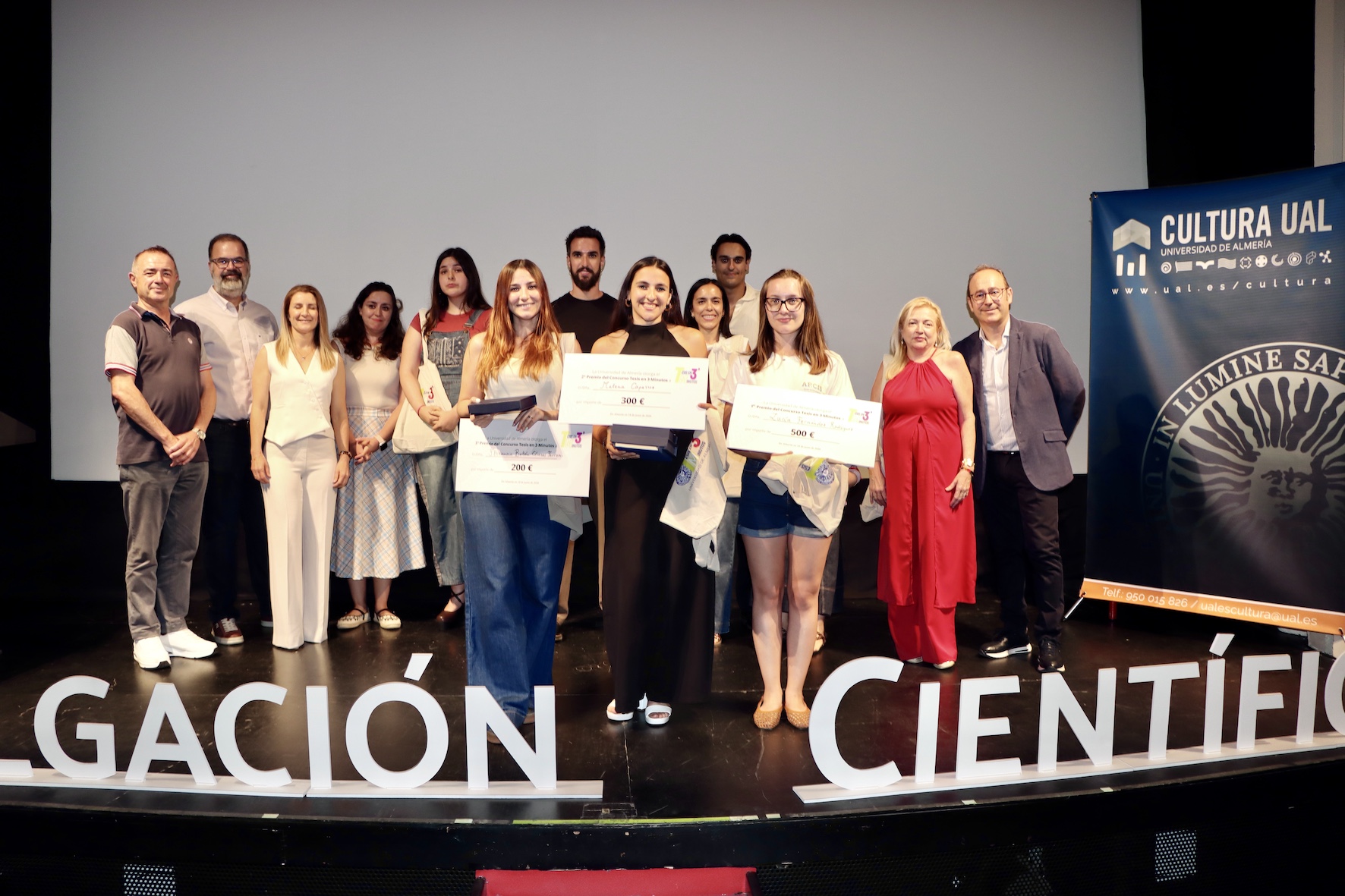
As a novelty, the winners of the first four editions took part during the introduction, from the stalls themselves: in chronological order Paqui Martínez, José Cebrián, Solaima Belachqer and Manuela González. Once the ideal atmosphere had been built to get the audience involved, the nine finalists, seven women and two men, took to the stage of the Teatro Apolo, addressing various fields of knowledge. Among them, History linked to education won, the topic researched by Lucía Fernández, the champion. In second place was Malena Caparroz, who in turn won the audience award, presented by Raquel Sánchez, general director of Communication at the UAL, with third place going to Florencia Belén Cáceres Ferroni.
Third place had a distinctly CIESOL flavour: researcher Florencia Belén Cáceres Ferroni, who made it onto the podium, carries out her work at the Solar Energy Research Centre within the Desalination and Photosynthesis unit. Her presence in the final, together with the reminder that Solaima Belachqer —also a CIESOL researcher— won a previous edition, highlights the centre's commitment to science communication and the ability of its young researchers to bring research on solar energy, water and biotechnology closer to society.
Source: news.ual.es